Home About Us Education Sport Bays  of  kamenjak Landmarks Nature House  of  Nature Gallery FAQ Interesting  facts Contact

You are here: Nature

THE FLORA

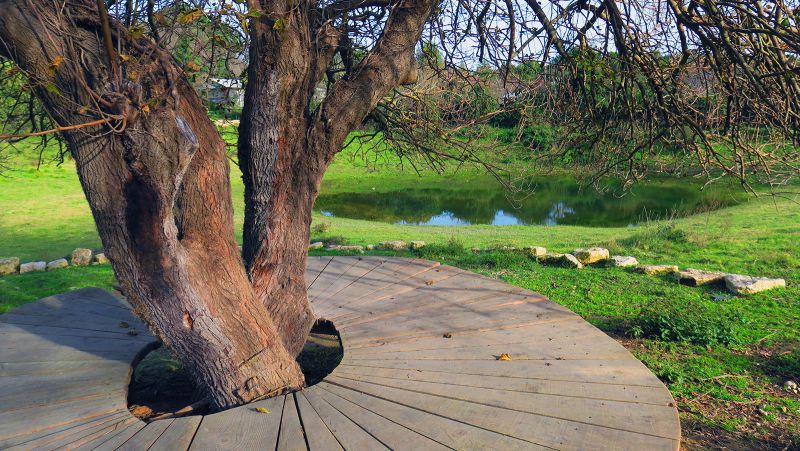
According to its geographic position, vegetation and climatic characteristics the peninsula of Kamenjak belongs to the eumediterranean vegetation zone (evergreen vegetation). In addition to the fact that it climatically demonstrates the characteristics of an island, a distinctive feature of Kamenjak is also ats soil which is partly composed of the Saharan sand. The strong desert storm winds blow it as far as the Adriatic. The plants that live here developed special adaptation skills an can endure high temperatures and summer droughts. Its floristic abundance is evident – 591 plant taxa have been observed over Kamenjak´s mere 5km2 of land. The exceptionally and valuable landscape of Kamenjak consists of a combination of the grasslands, the garigue and the maquis.

FORESTS

The Characteristic Mediterranean forest community, such as we find on the Kamenjak, is a typical combination of holm oak and the flowering ash (Orno – Quercetum ilicis). The evergreen trees of the holm oak (Quercus ilex) may grow up to a height of 10 or even 20 meters, depending on the quality of their habitat, while some of the trees may live for up to 1 000 years! Other evergreen species that we find in this forests community are the privet (Philyrea latifolia), the strawberry tree (Arbutus unedo) that in autumn adorns itself with red edible fruits, the aromatic laurel (Laurus nobilis) and others. A considerable portions of the Kamenjak is covered by the imported Aleppo pine (Pinus halepensis). We also find here many herbaceous plants such as protected cyclamen (Cyclamen repandum) and the asparagus (Asparagus acutifolius) well known to gourmets. Many creepers and deciduous trees such as the manna ash (Fraxinus ornus), terebinth tree (Pistacia terebinthus), evergreen rose (Rosa sempervirens) and other plants contribute to the thickness of the wood and the richness of the flora. As in many other places, the holm oak wood on Kamenjak is in its degraded phase, mainly because of the intervention of man, and we generally find it in its garigue or maquis phase of development.

GRASSLANDS

The largest area of the peninsula of Kamenjak is covered by grasslands of the sage plant (Salvia officinalis) and feather grass – facies juniper (As. Stipo-Salvietum officinalis, facies Juniperus macrocarpa). These open habitats are a favourable terrain for orchids and it is precisely on Kamenjak that we find the higest concentration of orchid varieties in Istria (28 species, 1 sub-species and 4 hybrids) there are also two species endemic to southern Istria: the Serapias istriaca and the Serapias x pulae (hybrid Serapias istriaca and Serapias lingua) the Kamenjak population of Bumble Bee Orchid (Ophrys bombyliflora) is most probably the largest population of this plant in Croatia today.

MAQUIS

Maquis appears as a consequence of excessive cutting or pest attack – it is represented by the degraded forest of the holm oak that grows up to the height of 5 meters and in which the tree layer is completely lost. It is pervaded by lush and tall bushes that together with creepers and climbing plants render this wood thick and impenetrable. We can find here briar root (Erica arborea), the Spanish broom (Spartium junceum), that in late spring and summer covers Kamenjak in yellow, the tasty blackberry (Rubus ulmifolius), the juniper (Juniperus oxycedrus), the myrtle (Myrtus communis) and many other plants. Maquis is very important because it prevents erosion and provides food and shelter for many insects, amphibians, reptiles, birds and mammals.

GARIGUE

Garigue appears uppon further degradation of the maquis due to extensive cutting and grazing. Garigue is the phase of permanent plant degradation. The garigues of Kamenjak cover an area of as many as 44,21 ha. These are sparse, open and luminous thickets whose height seldom surpasses 1 meter. Garigue is usually composed of very resilient, mostly poisonous, aromatic and thorny species. The intense scents of the Mediterranean that this community: the immortelle (Helichrisum italicum), the thyme (Tymus vulgaris) and the sage (Salvia officinalis). In spring and summer several species of bushy rockroses (fam. Cistus) adorn Kamenjak´s landscape with their white and pink flowers.

SEASHORE

Where living conditions are dictated by a high concentration of salt in the air we find plants such as the Woolly Chamomile (Anthemis tomentosa) and the Bindweed (Convolvulus lineatus). It is precisely here, on a narrow strip of Kamenjak, that one of the last populations of the Woolly Chamomile in Croatia still persists. In 1993. Kamenjak has been recorded as the second habitat of Bindweed in Croatia.

THE PROTECTED AND ENDANGERED PLANTS OF KAMENJAK
Cape Kamenjak is the habitat of numerous rare, endagered and endemic taxa among which 37 are classified as facing extinction. As many as 55,5% of the Kamenjak orchid varieties are critically endangered or vulnerable and the principal reason of their endageredness is the overgrowth of the grasslands and rocky terrain which is a consequence of natural succession. Endangered and rare are also the representatives of some other plant species.

Kamenjak is also one of the rare habitats of the Least Adder´s Tongue (Ophioglossum lusitanicum) and the only known habitat of the extremely rare and endagered Yellow Centaury (Cicendia filiformis) in Croatia. Both species are strictly protected by the Law. The seashore also abounds with many endangered and protected species (as many as 4 per square meter!). The treat to the survival of these species is represented by the constantly growing number of tourists that visit Kamenjak´s shores and these plant communities have become a priority in the protection of the Cape´s distinctive landscape.

THE FAUNA

Even though Kamenjak´s fauna has not been fully researched yet, those who know this peninsula well could tell us many interesting facts about its animals, and especially about its birds. This protruding tongue og Istrian land an important route for many migrating birds, especially Falconiformes and small birds. The ornithological fauna has been periodically researched since XIX century and modern researches will doubtlessly add new species to the current list of 192 birds. Among 51 nesting bird species one of the most prominent is the Short-toed lark (Calandrella brachydactyla), an increasingly endagered species of the cape´s meadows. Sparrowhawk (Accipiter nisus) and the European scops owl (Otus scops) nest in the forests of the Alepian pine.

The Little owl´s call repeated in precise 3 second intervals can be clearly and frequently heard in warm summer nights. Of the ordo Passeriformes one may encounter Larks, Blackbirds, Tits, Wrens, Pipits and Old world warblers. A subspecies of the Pallid swift (Apus pallidus iliryicus) is endemic to the Adriatic and its westernmost nesting places in Croatia are found here, in Kamenjak´s southern caves. During the summer and autumn migrations a whole series of rare and endangered birds of prey, such as the Lesser spotted eagle (Aquila pomarina), the Black stork (Ciconia nigra), the Red kite (Milvus milvus), the Black kite (M. Migrans), the Red-footed falcon (Falco vespertinus) and others fly over the cape.

In 1989 the Slovenian bilogist Narcis Mršić collected at Kamenjak the first five specimens of a completely new species of earthworm at the Cape and in Istria´s honour the species has been given its official taxonomic name Octodrilus istrianus. These hermaphrodite earthworms are brown in colour, between 240 and 275 mm in length and they play an inestimable biological role because they convert large pieces of organic matter (e.g. dead leaves) into rich humus, thus improving soil fertility.

The Eurasian green toad (Bufo viridis) has been observed on the cape and on two nearby islands, Ceja and Fenera. This species is not strictly protected only in the Republic of Croatia, it is also internationally recognized as a critically endangered species. It can grow up to 10 cm, with female being larger than the male. During the mating season the males court the females by joining in large singing choruses. However, while most of the tailless amphibians may boast a guttular croak, the call of the green toads is something quite unique in the amphibian world. Their high vibrating ´r-r-r-r-r´ can easily be mistaken for the singing of some cicada or cricket. They usually mate from April to June. The females lay a large number of eggs in strings long up to 3-4 meters.

The Mediterranean black widow (Latrodectus tredecimguttatus) is a regular inhabitant of Kamenjak. This is the most venomous European spider and therefore precautions must be taken when entering its habitat. Its name derives from the fact that the female kills the male after mating in June and July. The male is much smaller (3-5 mm in comparison with the 8-18 mm long female), it has an elongated abdomen, and its venom is harmless to humans. During the mating season the males cautiously approach the female´s nest because they are constantly exposed to potential treat. According to some sources an agile male can mate with several females in one season. The nests are usually found near or under rocks, rock fences and tree stumps, and may also be found in grass. The webs, made with very strong silk, are erratic in appearance and the prey caught in web can include a variety of insects (grasshoppers and beetles). A grown female (the only one that can bite humans!) can be recognized by its long legs, black velvety body and a spherical abdomen with a disparate number of red dots (0-18). the female is mostly timid and when disturbed it withdraws into the nest. Biting usually occurs when the spider is accidentally disturbed (lying in the grass, picking of herbs, turning of stones and similar). If you happen to encounter this animal please do not panic. Do not forget that the animal can also be frightened and that it defends instinctively. Spider bites are fairly infrequent and sufficient quantities of the antivenin serum are available.

After the hibernation the sun lures cold-blooded animals such as lizards and snakes out of their shelters. Among Kamenjak´s protected reptiles the ones most commonly encountered are the generally known Western green lizard (Lacerta bilineata) European common wall lizard (Podarcis muralis), European glass lizard (Pseudopus apodus), Balkan whip snake (Hierophis gemonensis) Four-lined snake (Elaphe quatuorlineata) and Black whip snake (Hierophis viridiflavus carbonarius). The European green lizard can easily been spotted in the thick, bushy vegetation exposed to the sun. Its lenght, short of his tail, may reach 13 cm and its tail may measure up to twice lenght of his body. It mainly feed on invertebrates but also on fruit, eggs and the offspring of other lizards and small birds. The Istrian coastal area is inhabited by a sub-species of the European common wall lizard (Podarcis muralis maculiventris) that differs from the other populations in Croatia for its pronunced colouration (especially of the troat and abdomen). The females lay eggs several times during the year and the males are distinctively territorial and fight among themselves in order to gain the right to reproduce.

Due to its long robust body (it reaches up to 1,5 meters in lenght!) the European glass lizard is often mistaken for a snake, however, this species is one of the two species of legless lizards that may be found in Croatia. The lizard´s favourite food are snail whose shells it can easily crush with it powerful jaw. It has an interesting way of freeing itself from the snail´s slime after feeding: it rubs the top of its snout on the ground. This animal may live up to twenty years in the wild.

The Black whip is a quick and agile animal that may be quite aggressive. During the mating season the males venture out of their usual territory in search of the females and can find females as distant as 3 kilometers away by following the trail of the females pheromones on the ground.

The sea

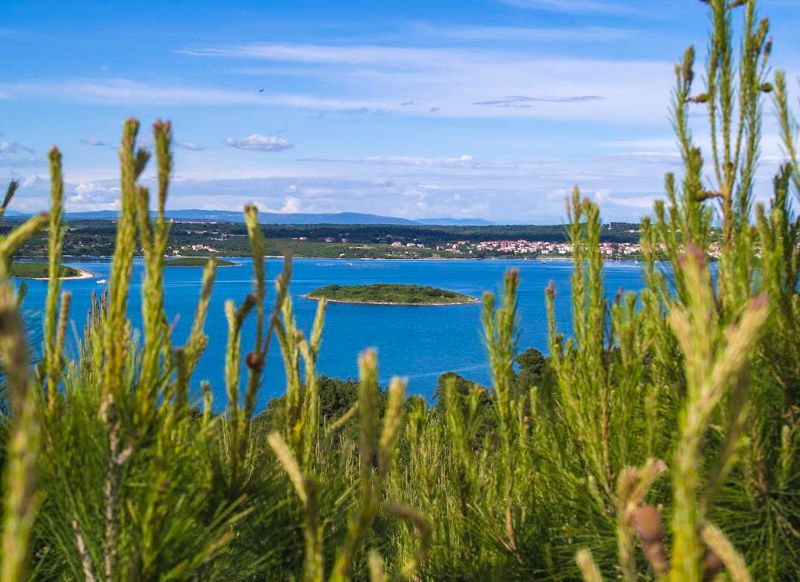
The indented shores of Kamenjak are characterised by a great variety of sea habitats and a richness of plant and animal life. Even though extensive research of the biocoenosis is still forthcoming, it is estimated that the undersea of the peninsula is inhabited by several thousand species of organisms among which the most prominent are economically valuable fish, crabs and mollusc's and many protected species.


Life on the Edge
The seashore on the edge between the land and the sea is an extremely dynamic area – it is exposed to the fluctuation of the tide, fierce battering of the waves, drought, significant oscillation of the temperatures and salinity. Only the most resilient organisms have managed to adapt to such an inhospitable environment developing special instruments of adaptation. Barnacles have formed dense colonies on the upper shores exposed to the waves. Like the neighboring rayed Mediterranean limpets, they survive in the atmospheric environment by shutting into their densely packed ˝houses˝ that retain moisture. A bit closet to the sea, on the rocks, the battle for space has been equally won by the bright red sea anemones (Actinia equina), the marine snails (Monodonta turbinata), the chitons (Middendorffia caprearum) and the marbled rock crab (Pachigrapsus marmoratus). At the very fringe of the sea, the rocky shores of Kamenjak are embellished by the dense, pink colored bioconstructions of the red algae Corallina mediterranea. Life on the Edg

The Empire of the Sea Urchins

A habitat rich with opulent settlements of algae can sometimes be transformed out of all recognition by the sea urchins and especially so by the purple sea urchin Paracentrotus lividus. Strictly vegetarian, the sea urchin can multiply to a great number and devour almost all the algae down to the rock. The endemic Mediterranean date shell (Lithophaga lihophaga) lives in the rock holes that it drills by secreting acid. Its growth rate is very slow: three years after it has attached itself to the rock it reaches barely 1 cm in length. If we calculate that its growth rate is og 3-4 mm a year and that the growth rate decreases with age we can estimate that an organism of 10 cm my be over 100 years old!!!

Opulence of Colours and Shapes

Below the sea surface the blueness of Kamenjak transforms into a sparkling kaleidoscope of colors made up by red, brown and green algae and by the communities of organisms that gravitate around them. Carpets consisting of several thousands of small umbrellas are formed by the green algae Acetabularia acetabulum. Each one of these umbrellas consists of one cell only. Some red algae (Peyssonnellia squamaria, Lythophyllum sp.) have developed complex mechanisms that incorporate calcium carbonate into their cell walls and with their robust bodies transform the surrounding sediment into new rocks. Over 600 species of cnidarians, sponges and annelids have been recorded in the Mediterranean sea that inhabit the surface of drill tunnels inside these biogenic structures. Numerous species of sponges, bryozoans and cnidarians that, despite the extraordinary shapes of their bodies, do not belong to the plan but animal kingdom, are inhabitants of this precoralline biocenosis. Together with many crabs, shells, snails, starfish and sea cucumbers they create the diverse Kamenjak.

Fish World

The undersea of Kamenjak is significant because of its rich fish stock, and among the economically important species the following are the most valuable: the common two-banded sea bream (Diplodus vulgaris), the black tail sea bream (Oblada melanura), the red mullet (Mullus surmuletus), the striped sea bream (Lithognathus mormyrus), the sharp-snouted sparus (Diplodus puntazzo), the pickerel (Spicara smaris), the seabass (Dicentrarchus labrax), the gilt head sea bream (Sparus aurata) and the Largescaled scorpion fish (Scorpaena scrofa). A notorious night predator - the European conger (Conger conger) inspires awe with its power and size at every encounter. . Little multi coloured blennies can be often seen peeking out from holes in the rocks. During almost every immersion one can encounter a shoal of damelfish (Chromis chromis), and in the summer, near the rocks, the attentive observer will spot their tiny progeny, tinged a fluorescent blue. To the nature lovers the undersea of Kamenjak reveals itself through coloutfulness of the Mediterranean rainbow wrasse (Coris julis), the black faced blenny (Trypterigion delaisi), the goby (Gobbius sp.), the painted comber (Serranus scriba) and other fish.

Protected and Endangered Marine Species

The undersea of Kamenjak is inhabited by the following species protected by the Environmental Protection Act: the noble pen shell (Pinna nobilis), the date shell (Lithophaga lithophaga) and the lurid cowry (Luria lurida). Algae of the genus Cystoseira, sponges Geodia cydonium, Tethya sp., Axinella canabiana and Axinella polypoides and all the sea cucumbers (Holothurioides) are also protected. A critically endangered sea flowering plant, Posidonia oceanica, forms it last settlements in Istria precisely in the waters surrounding Kamenjak. The lovely seahorse is also included on the list (Hippocampus guttulatus) which, to the surprise of many, is also a fish. The loggerhead sea turtle (Careta careta), the bottlenose dolphin (Tursiops truncatus) and recently, the Mediterranean monk seal (Monachus monachus), for which it was until recently thought that it had completely disappeared from the Adriatic, can sporadically be encountered in the vicinity of Kamenjak. Owing to the loss of their habitat, some species of seagulls (Laridae) and grebes (Podicipedidae) that act as a connecting link between the ecological systems of the sea and the land, have also been protected. The loggerhead sea turtle (Caretta caretta) and the bottlenose dolphin (Tursiops truncatus) have occasionally been sighted in the waters surrounding Cape Kamenjak before, but it is only recently that there have been sightings of the Mediterranean monk seal (Monachus monachus), considered extinct in the Adriatic. Due to the loss of their habitat, gulls (Laridae) and grebes (Podicipedidae) have previously been protected, birds which represent a link between the marine and the terrestrial ecosystems.

The Mediterranean monk seal


Click to see larger image

The Mediterranean monk seal does not have the power of speech, but shouldn’t we recognise the seal’s needs and speak in its name? The Mediterranean monk seal, Monachus monachus, or, as the locals like to call this lovely sea mammal, “sea man”, or “sea monk”, is a seal with a smiling face and large black eyes. The principal characteristic of this animal is its fantastic ability to adapt to life in the marine ecosystem despite the pressures exerted by man on the seal’s survival and on its environment. For thousands of years, this seal has lived in the warm and moderately-warm seas of the Atlantic Ocean and the Mediterranean, and therefore also of the Adriatic. It used to be quite common to sight whole groups of monk seals basking in the sun, or to see female members of this species feeding their pups on open beaches.

Their interesting behaviour, of a slightly spiteful nature, has formed the basis of many a legend, which still reflects the nature of the coexistence between the monk seal and humans, evoking memories of the not too distant past, of difficult but also of happy times. The stories mostly derive from the islands of the southern Adriatic, where it was more common to encounter the monk seal. It was considered that a woman would give birth more easily if she lay on a monk seal skin. Equally, a seafarer was going to embark on a lucky and successful voyage if he carried whiskers of the monk seal as a good-luck-charm in a pouch around his neck. Stories also abound of these mammals emerging from the sea at night to feast on fresh grapes..


Humans are known to have hunted the monk seal throughout history, but until the nineteenth century the extent of the hunt was limited, leaving the seal to lead a relatively peaceful life. It was in the 19th century that the monk seal started to be considered a nuisance by man and it was cruelly hunted down wherever it was found. Monk seals feed on fish, crabs and crustaceans, food which humans hunt for their own needs. For this reason, man decided that the large expanse of the sea was not big enough for both species. The monk seal presented competition for the same kind of food, in addition to being the main culprit for torn fishing nets. It is these torn fishing nets which became more important than the life of this sea creature. Fishermen killed the monk seal everywhere, while they searched the shores and caves for the seal’s pups, which they battered to death with sticks.

A large number of adult and juvenile seals lost their lives by getting entangled in the notorious fishing nets “which they so loved to tear apart”. The aim was to get rid of the monk seal, and man was on the best way of achieving this aim. Ruthless killing decimated the seal’s numbers with great speed, and, due to the seal’s slow rate of reproduction (one pup every two years), the monk seal was incapable of recovering its numbers. The hunt was not the only reason for the seal’s disappearance. Sea pollution and the urbanisation of the sea shores also accounted for the seal’s disappearance. The monk seal started making home in isolated places inaccessible to man, while pups were born in underwater caves. As generations passed, so the image of the monk seal serenely swimming in the sea started to fade. The alarm was first raised in 1935, when the Marine Authority in the city of Split resolved to officially protect the monk seal in Croatia. Nevertheless, prizes continued to be handed out for every seal which was culled, and in 1964 the last remaining specimen of the monk seal was exterminated on the Croatian side of the Adriatic Sea. Since that year, the monk seal was deemed no longer to exist in the Adriatic. The Red Book of the International Organization for the Protection of Nature and Natural Resources carried this species as extinct in the Adriatic.

In the 1990ies, several specimens of the monk seal from the Aegean Sea swam into the Adriatic in search of food, however, they did not survive. As the seal’s fate was considered sealed in the archives of natural sciences in Croatia, the increasing number of sightings of this mammal on the Croatian side of the Adriatic has made waves in recent years. Although it seemed to have completely disappeared, the monk seal is making a steady return to the shores which have been its home for thousands of years. Frequent sightings of the monk seal permit the conclusion that its population in Croatia is recovering. It is believed that the Adriatic Sea homes approximately 20 monk seals, of the 300 surviving animals. The monk seal is one of the most endangered mammals on earth. It is threatened with extinction and requires protection. The disturbance and the killing of the monk seal carry a hefty fine of 100 000 Croatian kuna, a small price, however, considering the life of such a special creature. Since 2009, the monk seal has been sighted severally in the sea off southern Istria and especially around the caves of Cape Kamenjak. These sightings have come as a great surprise because this area is not isolated and the monk seal encounters human beings.

The maritime zone around Cape Kamenjak is a very important biological habitat, while its climate bears astonishing resemblance to that found on isolated open-sea islands. Although the area teems with tourists in the summer months and resembles a true beehive, the increased number of sightings of the seal seem to confirm the speculation that this mammal has adapted fantastically well to life in an area of intense tourist pressure. The monk seal is rarely seen in the summer months, and it is not known where it hides, but it is well-recorded that in the autumn and winter months it likes to visit the caves of Cape Kamenjak. Indeed, Cape Kamenjak is much liked by all, because in addition to featuring a unique natural habitat, it also features the monk seal!

The monk seal may not be sighted by everybody, but the knowledge that this animal is around gives us the hope that the idea of the untouched Mediterranean is still alive. Has the seal forgiven us for all the troubles we have heaped upon it during the past centuries, and has it given us its trust again? The fate and the future of the monk seal rest again with mankind, who once threatened it with extinction and who now makes an effort to protect it. Some may, wrongfully, still hate the monk seal, or, subconsciously, perhaps envy the seal’s freedom. Let us not forget, however, that nature can exist without man, but man cannot exist without nature!